Portable FRP Security Guard Cabins: Sizes & Buying Guide
A security cabin may be small compared with the rest of a factory, residential complex or commercial property, but it has an important job.
Security personnel may spend several hours inside the cabin every day while monitoring vehicle entry, visitors, deliveries and pedestrian movement.
That means a good security cabin needs more than four walls and a roof.
It should provide adequate working space, visibility, protection from rain and heat, ventilation, lighting and a practical layout for the security staff using it.
Portable FRP security guard cabins are one option for sites that need a compact, prefabricated and relatively easy-to-install security structure.
They can be used at:
- Factory entrances
- Industrial gates
- Residential societies
- Warehouses
- Construction sites
- Commercial complexes
- Parking entrances
- Schools and institutions
- Infrastructure projects
- Toll and access-control points
- Industrial estates
But what size should you choose? What should the cabin include? And what should you check before ordering?
Let's look at the important points.
1. What Is an FRP Security Cabin?
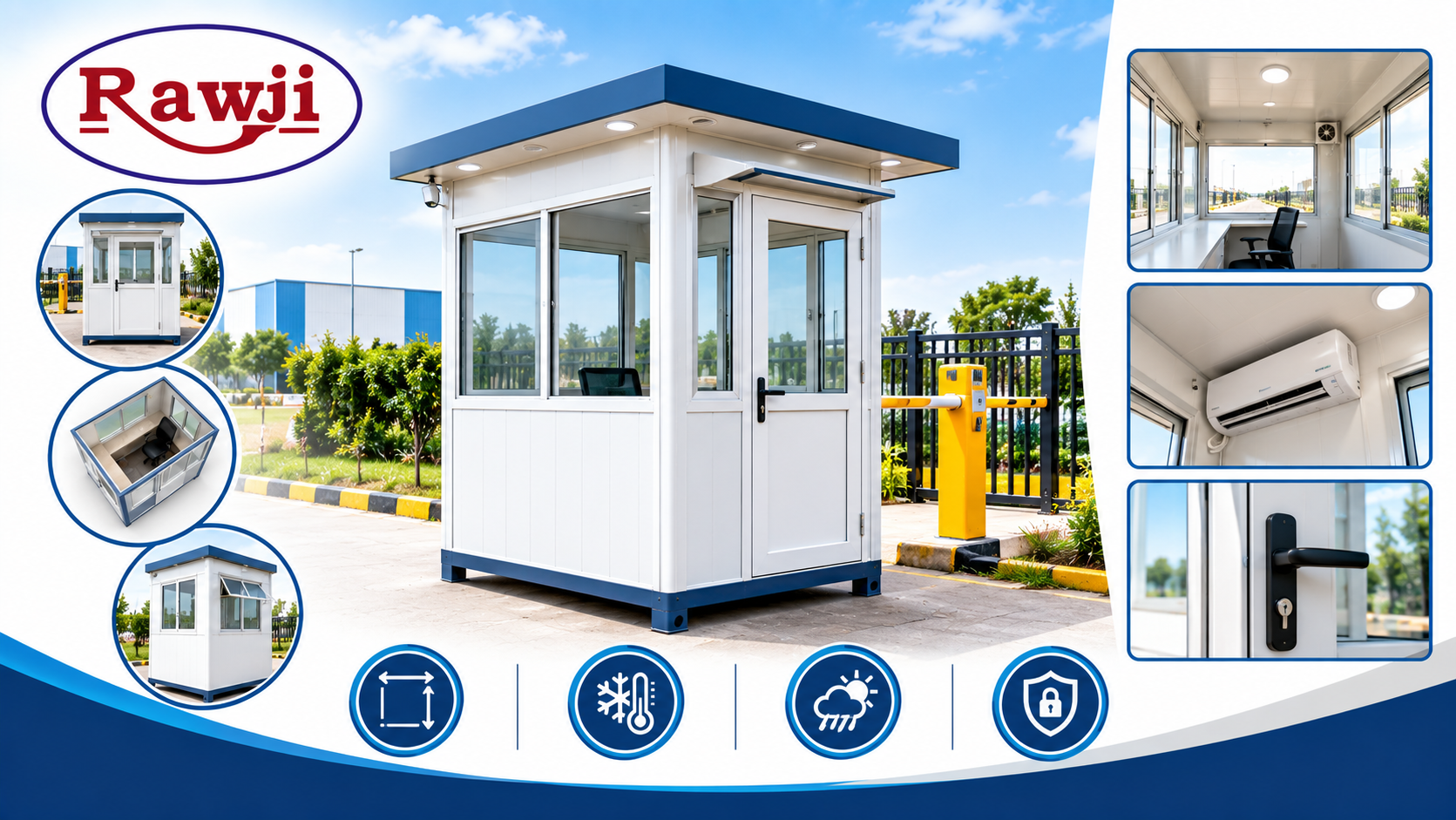
An FRP security cabin is a prefabricated enclosure manufactured using fibre-reinforced plastic (FRP) or composite construction.
The cabin is designed to provide a dedicated working space for security guards, gate operators or access-control personnel.
Depending on the design, an FRP security cabin can include:
- FRP walls
- Roof
- Windows
- Door
- Flooring
- Electrical points
- Lighting
- Ventilation
- Counter or work desk
- Chair space
- Security equipment provisions
The exact construction varies between manufacturers.
Therefore, buyers should ask for the complete specification rather than comparing cabins only by their outside dimensions.
2. Why Are FRP Cabins Used for Security Applications?
Security cabins are often installed outdoors.
That means the structure has to deal with conditions that an ordinary indoor room does not.
The cabin may be exposed to:
- Sunlight
- Rain
- Dust
- Humidity
- Temperature changes
- Wind
- Frequent entry and exit
- Continuous daily use
FRP is used in many outdoor applications because composite construction can provide useful resistance to moisture and corrosion.
This can be particularly relevant at industrial sites where a conventional metal structure may require periodic surface protection and maintenance.
However, the actual performance depends on the cabin's construction, materials, installation and environment.
3. Choosing the Right Security Cabin Size
There isn't one standard size that works for every site.
The right size depends primarily on how the cabin will be used.
A small cabin may be sufficient when it is intended for one security guard and basic visitor monitoring.
A larger cabin may be preferable when the operator needs:
- A desk
- Computer
- Visitor register
- CCTV monitor
- Intercom
- Access-control equipment
- Storage
- Seating for more than one person
Common project requirements may include compact footprints such as:
4 × 4 ft
5 × 5 ft
6 × 6 ft
6 × 8 ft
8 × 8 ft
These are examples rather than universal standard sizes. The actual cabin can be specified according to the available site space and intended use.
4. Think About the Security Guard's Working Position
One of the most overlooked aspects of cabin design is the guard's actual field of view.
A security guard may need to monitor:
- Incoming vehicles
- Outgoing vehicles
- Pedestrian gates
- Visitor movement
- Delivery vehicles
- Barrier arms
- Parking areas
A cabin with a poorly positioned window can make the guard's job unnecessarily difficult.
Before finalizing the design, consider:
Where does the guard sit?
Which direction does traffic approach from?
Where should the main window face?
Is visibility required on one side or multiple sides?
The window layout should follow the site's traffic and security pattern.
5. Windows Are More Important Than They Look
A security cabin is fundamentally a visibility-based workspace.
Windows allow the guard to observe activity without continuously leaving the cabin.
Depending on the application, buyers may consider:
- Front viewing window
- Side windows
- Sliding windows
- Fixed glass
- Service window
- Counter window
Sliding windows can be particularly useful at vehicle gates where the guard needs to communicate with drivers.
The exact glazing and frame specification should be selected according to the environment and project requirements.
6. Weather Protection Should Be Part of the Design
An outdoor security cabin should provide protection from the weather.
The roof and wall construction should be appropriate for the local environment.
Consider:
- Rainfall
- Sun exposure
- Wind
- Humidity
- Temperature
- Drainage
- Roof overhang
The door and window openings should also be properly detailed.
A cabin may have a weather-resistant shell, but poor installation around joints, frames or service penetrations can still create water-entry problems.
That is why buyers should ask about the complete cabin construction, not just the FRP panel material.
7. What About Heat Inside an FRP Security Cabin?
This is a common concern in Indian outdoor installations.
A cabin exposed to direct sunlight can become uncomfortable if ventilation and thermal design are not considered.
Depending on the application, buyers can discuss:
- Ventilation windows
- Air vents
- Roof design
- Insulation
- False ceiling
- Electrical provision for a fan
- Air-conditioning provision for larger cabins
A cabin intended for an eight-hour security shift should be designed differently from a small booth used only intermittently.
Thermal comfort is therefore part of the cabin specification.
8. Electrical Requirements Should Be Planned Before Manufacturing
A security cabin may need considerably more electrical infrastructure than a simple room.
Typical requirements can include:
- LED light
- Ceiling fan
- Electrical sockets
- CCTV monitor
- Computer
- Intercom
- Access-control system
- Network equipment
- Mobile charging point
- Air conditioner in larger cabins
Tell the manufacturer about these requirements before production.
This allows electrical points and cable entry locations to be planned into the cabin.
It is much cleaner than cutting openings after installation.
9. Flooring Matters Too
The floor should be suitable for the intended environment and daily use.
Consider:
- Foot traffic
- Chair movement
- Cleaning
- Moisture
- Equipment weight
- Cable routing
If the cabin is installed directly on a prepared concrete platform, the manufacturer should provide the appropriate installation/support arrangement.
For temporary projects, the installation method may be different from a permanent industrial gate cabin.
10. Portable Does Not Mean "Move It Every Day"
The term portable security cabin generally means that the cabin is prefabricated and can be transported or relocated more easily than a conventional masonry structure.
It does not necessarily mean that the cabin should be moved frequently.
Once installed, the cabin may remain at a factory gate, construction site or commercial entrance for years.
Therefore, ask the supplier:
- How is the cabin transported?
- How is it unloaded?
- What foundation or platform is required?
- How is it secured?
- Can it be relocated later?
- What equipment is needed for relocation?
These details are especially important for construction and infrastructure projects.
11. FRP Security Cabins for Industrial Sites
Industrial facilities can have more demanding requirements than residential gates.
A factory security cabin may need to support:
- Vehicle entry control
- Visitor registration
- CCTV monitoring
- Delivery documentation
- Worker access control
- Shift-based security operations
In such cases, the cabin becomes a small operational workplace rather than simply a shelter.
The specification may therefore include:
- Larger floor area
- Multiple windows
- Electrical points
- Work counter
- Storage
- CCTV provision
- Better ventilation
- Comfortable seating
This is where a customized FRP security cabin can be more practical than a basic catalogue model.
12. FRP Security Cabins for Construction Sites
Construction projects often need temporary security facilities before the permanent building is completed.
A portable cabin can provide a dedicated location for security personnel at:
- Site entrances
- Material gates
- Worker entrances
- Parking areas
- Equipment yards
The ability to transport the cabin to another location can also be useful when the project layout changes.
For construction applications, discuss transportation, installation and eventual relocation before ordering.
13. Don't Forget the Door
The door is one of the most frequently used components of a security cabin.
Check:
- Door size
- Opening direction
- Hinges
- Lock
- Handle
- Frame
- Weather sealing
- Threshold
- Frequency of use
For an industrial gate operating 24/7, the hardware requirement can be significantly different from a small residential security booth.
The door should be selected as part of the complete cabin system.
14. What Should You Check in the FRP Construction?
When comparing FRP security cabins in India, ask the manufacturer about the construction.
Important questions include:
- What FRP material is being used?
- What is the wall construction?
- What is the roof construction?
- What is the floor construction?
- How are panels joined?
- How are doors and windows framed?
- How are electrical cables routed?
- What surface finish is provided?
- Is the cabin suitable for outdoor exposure?
A professional manufacturer should be able to explain the construction rather than providing only a photograph and price.
15. Customized FRP Security Cabins
Standard cabins are useful when the project requirements are straightforward.
But some sites require something different.
For example:
- Additional windows
- Larger counter
- Two-person workspace
- Special dimensions
- CCTV provision
- Air-conditioning provision
- Additional electrical sockets
- Different door position
- Special colour
- Branding
- Equipment storage
In such cases, customized FRP security cabins can be designed around the site requirements.
Provide the manufacturer with a simple drawing or dimensional sketch wherever possible.
This reduces misunderstandings during production.
16. FRP Security Cabin vs Conventional Site Construction
For a permanent building, masonry construction can obviously make sense.
But for a small security booth, constructing a complete room on-site can involve:
- Masonry work
- Plastering
- Painting
- Roofing
- Electrical work
- Flooring
- Finishing
- Longer site coordination
A prefabricated FRP cabin can consolidate many of these elements into a factory-manufactured structure.
This can be useful when the project requires a functional security cabin within a relatively short installation schedule.
The actual time and cost advantages depend on cabin specification, site access and installation conditions.
17. What Should a Buyer Ask Before Ordering?
Before requesting a quotation, prepare these details:
Site Information
- Installation location
- Indoor or outdoor
- Available space
- Ground/platform condition
Cabin Requirements
- Length
- Width
- Height
- Number of occupants
- Door position
- Window positions
Electrical Requirements
- Lighting
- Fan
- AC provision
- CCTV
- Computer
- Intercom
- Electrical sockets
Operational Requirements
- Security shift duration
- Visitor management
- Vehicle monitoring
- Equipment storage
- Counter requirement
Environmental Requirements
- Sun exposure
- Rain
- Humidity
- Coastal conditions
- Industrial environment
Providing these details will help the manufacturer recommend the right cabin instead of quoting a generic model.
18. Portable FRP Security Cabin Buyer Checklist
Before placing the order, confirm:
☐ Cabin dimensions
☐ Number of occupants
☐ Door size and position
☐ Window arrangement
☐ Guard visibility
☐ Wall construction
☐ Roof construction
☐ Floor construction
☐ Ventilation
☐ Thermal requirements
☐ Electrical points
☐ CCTV provision
☐ Desk/counter requirement
☐ Outdoor exposure
☐ Foundation/support requirement
☐ Transportation arrangement
☐ Installation method
☐ Customization requirements
☐ Warranty and product documentation
This checklist is especially useful when comparing quotations from multiple FRP security cabin manufacturers in India.
Final Thoughts
A security cabin should be treated as a small working environment rather than simply a prefabricated box.
The right design depends on who will use it, how long they will stay inside, what they need to monitor and what equipment they need to operate.
For a basic gate, a compact FRP security booth may be enough. For a busy factory entrance, a larger cabin with multiple windows, electrical provisions, CCTV equipment and a work counter may be more appropriate.
Before ordering, confirm the dimensions, visibility, weather protection, ventilation, electrical requirements and installation method.
For projects requiring portable FRP security cabins, guard booths, customized security cabins or industrial gate cabins, Rawji Exports can discuss the site requirements and cabin configuration.
For enquiries, call Rawji Exports at +91 9920228162.